
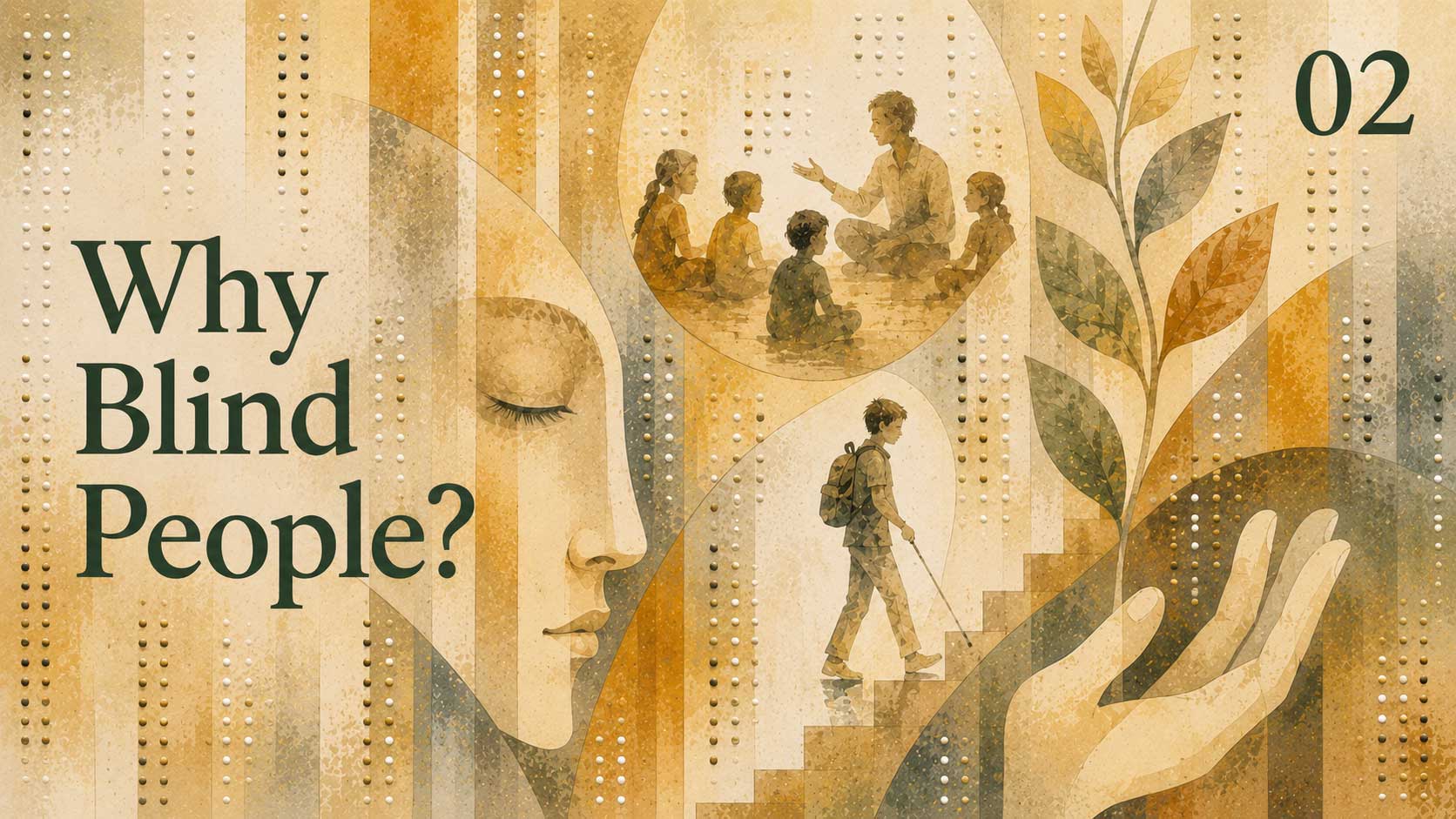
The village was not very far from the world of schools and institutions, but it felt like a different world. Life there was organised around the things that had to be done every day. The fields needed attention, the household had to be managed, and whatever work a family could do for itself was valuable.
Someone had told us about a blind child living with his family in one of the homes there. The child was not going to school, so a visit was made to meet the parents and understand what was stopping them from sending him.
The family welcomed the conversation, but the idea of sending the child to school did not seem particularly attractive to them. They had their own understanding of what the future might look like.
The parents were not asking questions to argue against education. From where they stood, their question was perfectly reasonable.
“Padh likh kar kya karega? Jinko dikhai padta hai, unhi ko padh likha kar kaun si naukri mil jaati hai? Jo hamare blind bachche ko milegi?”
Children who could see were studying and still struggling to find jobs. What job would their blind child get?
They had already found a role for him within the family. He could stay at home and help with whatever work he was capable of doing. When there was work in the fields, he could help there too. He could dig potatoes. It was not a career, and nobody was pretending that it was. But it was useful work, and the child was part of the family.
From the parents’ point of view, that was more certain than sending him away to study for years without knowing what would come at the other end.
Education promised a possibility. The work at home offered something immediate and tangible.
There was something uncomfortable about that conversation because it was difficult to dismiss their reasoning. They were not saying that their child was incapable of doing anything. In fact, they were already thinking about what he could do. Their concern was whether education would give him anything more than what he already had at home.
Perhaps that was the real question. What could education actually change in this child’s life?
The conversation stayed in the mind because it revealed a problem that was much larger than one child not attending school. For some blind children, the question was not how to improve education. The first question was whether education would reach them at all.
And the reasons did not always begin with the child.
Poverty could make treatment difficult. Lack of awareness could mean that a problem with eyesight was not addressed in time. Poor nutrition could also contribute to avoidable vision loss. Once a child became blind, the same poverty could make everything that followed more difficult. The cost was not limited to education. There could be the cost of treatment, travel, assistive equipment, accommodation or simply finding someone who could accompany the child to school.
For a blind girl, the difficulty could be greater still. Many families were uncomfortable sending a daughter alone to a hostel or allowing her to travel to school without someone accompanying her. If someone had to take her and bring her back, that meant another person’s time, travel expenses and sometimes the loss of a day’s work. A school could exist, but reaching it could still be beyond the family’s means.
Then there was another problem. Even when blind children did reach school, the school itself could become a world apart.
Many institutions were located away from ordinary city life. Students lived there, studied there and received vocational training. Teachers and other staff worked within the same environment. The campus provided education, training and safety, but it also meant that much of the child’s experience remained within its boundaries.
That raised another question. How much can a person learn about the world without actually being part of it?
A sighted child learns many things without anyone calling them lessons. A journey on a city bus teaches something. Taking an auto-rickshaw teaches something. Going to a market, standing in a queue, dealing with a shopkeeper, finding a railway platform, listening to strangers talk, encountering kindness or rudeness, getting confused and finding a way out, all of these become part of learning.
Much of life is learned while simply moving through it.
For a blind student who spends most of childhood inside an institution, many of those experiences can remain out of reach. The child may receive an education and vocational training, but still have limited experience of the world in which that education is supposed to be used.
It was an uncomfortable contradiction. Institutions existed to prepare blind children for life, yet the very structure of those institutions could sometimes keep them separated from everyday life.
And outside the institutions, another reality existed. There were blind people living in the same cities and towns as everyone else, yet they were rarely seen as part of ordinary public life. They were not commonly seen shopping in markets, travelling independently, using railway stations or simply going about their daily lives. When a blind person was seen on a road, in a bus or at a railway station, the image most people associated with blindness was often that of a beggar.
The problem was beginning to look very different.
It was not simply about building more facilities or providing more training. It was about whether blind people had a genuine opportunity to participate in the world around them.
That thinking began shaping the early work. A community gathering was organised in Agra in October 2006. A helpline followed in December, and in January 2007, a symposium titled “Blindness: Issues and Dilemmas” brought doctors, district administration officials, educators and others into the same conversation.
The work gradually expanded into workshops, meetings and skill-development programmes covering Braille, mobility and orientation, computer skills and personality development.
The thinking behind it was becoming clearer. A blind person did not need to be protected from the world by keeping the world at a distance. They needed opportunities to learn how to navigate it, participate in it and eventually find their own place within it.
Some of that learning could happen in a classroom. Some could happen through training. But a great deal of it had to happen outside, through ordinary life and ordinary interaction with other people.
The real classroom was the world itself.