
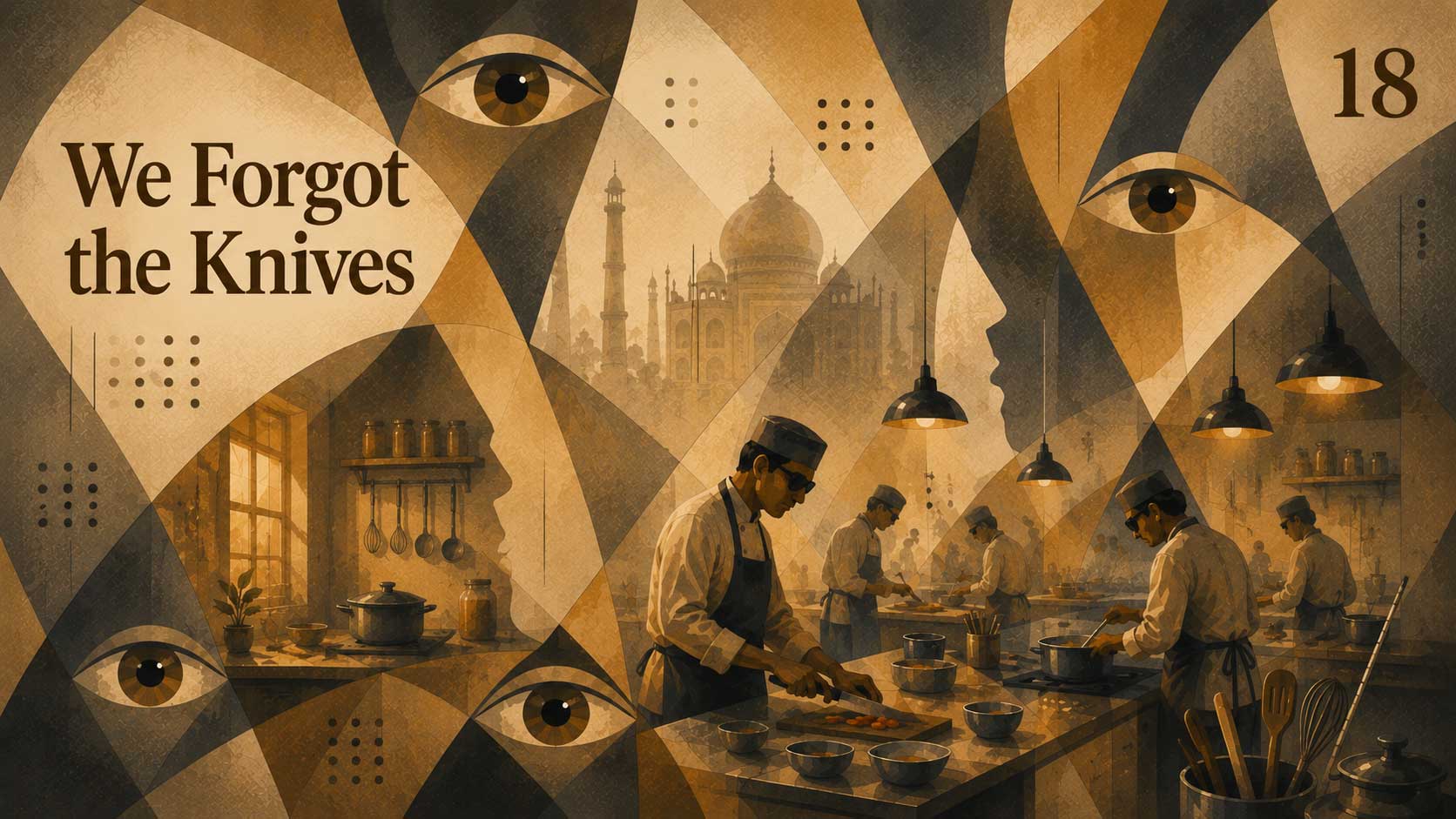
The market was still crowded when we started running from one shop to another.
It was past nine in the evening, but the vegetable vendors were still calling out to customers and trying to clear their remaining stock before closing. The air smelled of fresh coriander, ripe tomatoes and vegetables that had been sitting out all day. Auto-rickshaws squeezed through the narrow lane, people moved around us carrying bags, and one shop after another had already begun pulling down its shutters.
We had a list in our hands and very little time. One shop was never enough; we needed everything in quantity. At one stall, we were buying onions while the vendor weighed them on an old metal scale. At another, we were looking for potatoes and other vegetables from the ingredient list. Every time we crossed something off, we discovered something else that still needed to be found.
At one point, a man walked past carrying a stack of wooden chopping boards. We stopped him and asked where we could find more. He pointed further down the lane. We picked up our bags and moved on, trying to keep track of what we had bought and what was still missing.
By then, the list had become less like a shopping list and more like a race against the clock.
We found the chopping boards. We found the oil dispensers. We collected the vegetables and other ingredients. Shops were beginning to close around us.
We were still missing the knives.
It was late in the evening, and the first day of Golden Eye Chef was only a few hours away.
A few hours earlier, we had thought we were almost ready.
Then we discovered that we were not.
The first day’s theme was local food. We had told the participants that they could bring their own ingredients and, if they needed particular utensils, they could bring those too. It seemed simple enough. We were not from the food industry, and we had never organised a cooking competition before, but we had spent months preparing for the event. We thought we had covered the important things.
Then, as the final preparations began, we realised that there were several things we were expected to provide for every participant. Knives, chopping boards and oil dispensers were among them. We also needed to make sure that the ingredients required for the dishes were available according to the lists we had received.
Suddenly, the preparation for a cooking competition had become a late-night shopping expedition.
And perhaps that was fitting, because we had been uncertain about almost everything from the beginning.
We had worried for months whether anyone would even participate. Some people told us that without a large cash prize, blind people might not see enough reason to come.
That was only one of the doubts we were carrying.
We had travelled, spoken to people in the blind community and contacted organisations, yet we had not found the large network of blind cooks we had imagined we might need. We knew that some blind people cooked at home, but entering a competition was something entirely different.
Then there was the question of finding a venue.
When we approached people about hosting a cooking competition for blind participants, we repeatedly encountered the same disbelief. Why did blind people need a cooking competition? Could they really cook in a professional kitchen? Would it actually work?
We were asking people to trust an idea that many of them found difficult to imagine.
Funding was no easier. We did not belong to the food industry. We had no experience organising culinary competitions and no established network of chefs or food companies. When we approached potential supporters, we often found ourselves explaining not only what Golden Eye Chef was, but why it needed to exist at all.
Still, we decided to go ahead.
We started speaking to blind people wherever we could. We held teleconferences and talked to people in different parts of the country. Sometimes those conversations happened while we were working from completely different places. I remember speaking with people from the blind community even while I was in Gangolihat, Uttarakhand, trying to explain the idea and understand whether there would actually be people willing to participate.
Slowly, things began to move.
We started receiving cooking videos from potential participants. Those videos became important because they gave us something we could show to people who were still doubtful. Instead of explaining that blind people could cook, we could now show them someone actually cooking.
A chef in Agra also became a tremendous support to us. He helped us with the venue and with many of the practical aspects of the competition. His support was particularly valuable because we were learning things that were completely outside our own experience.
Even the trophy had its own little journey.
We were in Agra, a city famous for its marble craft, so we wanted the trophy to carry something of the city with it. We decided to use a marble plate, but then came the question of how to put the Golden Eye Chef logo onto it. We searched for local artisans and eventually approached craftsmen who worked with peetal, carving designs into metal. We explained what we wanted and worked with them to find a way of putting the design onto the marble.
Piece by piece, the competition was becoming real.
We communicated with thousands of people, including chefs and organisations working with blind people. Eventually, we had participants, judges, venues and a three-day programme spread across three different locations.
But having everything arranged on paper did not mean we knew how to run a cooking competition.
The night before the first day had already taught us that.
The next morning brought another lesson.
The inauguration hall was not ready when it should have been. People from the venue kept coming to us with questions and asking us to arrange one thing after another. Because I had never organised a cooking competition, I did not always know which requests were essential and which could simply be left aside.
I was trying to solve everything at once.
Then the chef who had been supporting us stepped in.
He looked at the situation and began simplifying things. There was no need to make everything complicated, he told the venue people. They did not need to keep pushing every small decision towards us. They needed to make the basic arrangements, keep things simple and start the programme.
The atmosphere changed.
The event began.
The contestants entered the kitchens, and something that had existed for months only as an idea suddenly became real. They were standing at their workstations, preparing food, working with ingredients and dealing with the pressure of time.
For us, it was the first real test of whether the idea we had been defending for so long could actually work.
And it did.
The second day was relatively quiet. Before the finale, the participants visited the Taj Mahal, giving them some time away from the competition before returning for the final day.
Then came the finale.
Professional and celebrity chefs joined the jury, and the contestants cooked in front of people who were accustomed to judging food professionally. The participants also spoke about what the experience meant to them. Some had spent most of their lives cooking in familiar home kitchens; now they were working in unfamiliar surroundings, with different equipment and within the pressure of a competition.
One participant later described how the experience made her realise that she could cook not only in her familiar home kitchen, where she knew her utensils and ingredients, but also in a professional kitchen using professional knives and equipment.
That was exactly the kind of discovery we had hoped Golden Eye Chef would create.
But there was another small moment that stayed with us.
During the kitchen setup, the people arranging the gas stove were getting everything ready. We asked them to provide a gas lighter for the contestants.
The response was simple.
There was a matchbox.
We explained that this was a cooking competition for blind people and that asking them to use a matchbox was not a sensible arrangement.
The man listened and then put his hand on his forehead.
It was a small gesture, but we understood what had happened. He had been thinking about setting up an ordinary kitchen. We were asking him to think about the same kitchen from the perspective of someone who could not see.
That was one of the things Golden Eye Chef kept doing to us. It made ordinary things visible in a different way.
A knife was not simply a knife. A lighter was not simply a lighter. Even the arrangement of a kitchen could become an accessibility issue.
And then there was the reaction from the audience.
We were livestreaming the competition on YouTube when one of the earliest comments appeared:
“Inko kya jarurat pad gai khana banane ki?”
Why did they need to cook?
It was only one comment, but it contained exactly the assumption we had been encountering from the beginning. The same doubt that had made it difficult to find venues and funding was now appearing in the comments while the competition was actually happening.
We did not need to answer it.
The contestants were already answering it.
They were cooking.
Looking back, that may have been the most important part of the first Golden Eye Chef. It was not simply that we had managed to organise a three-day competition across three venues. It was that we had created a situation in which people could see something they had previously been unwilling to believe.
We had started with very little certainty. We were not from the food industry. We had no experience in running culinary competitions. We did not know whether enough blind people would participate. We struggled to find venues, struggled to find funding and spent months trying to convince people that the idea was worth taking seriously.
And on the night before the first day, after all those months of planning, we discovered that we had forgotten some of the most basic things a cooking competition needed.
So we went to the market.
We bought the vegetables and ingredients. We found the chopping boards and oil dispensers. We kept searching through the closing shops until we had what we needed.
And eventually, we found the knives.
The mistake still makes us smile.
But it also says something about how Golden Eye Chef was built. We were trying to organise something completely outside our experience, for people whose abilities were being questioned even before they entered the kitchen.
We did not know everything we needed to know.
We learned some of it from the chefs, some from the participants, some from the people around us, and some from our own mistakes.
That night in the market was one of those lessons.We forgot the knives. But we didn’t forget why we were there.