
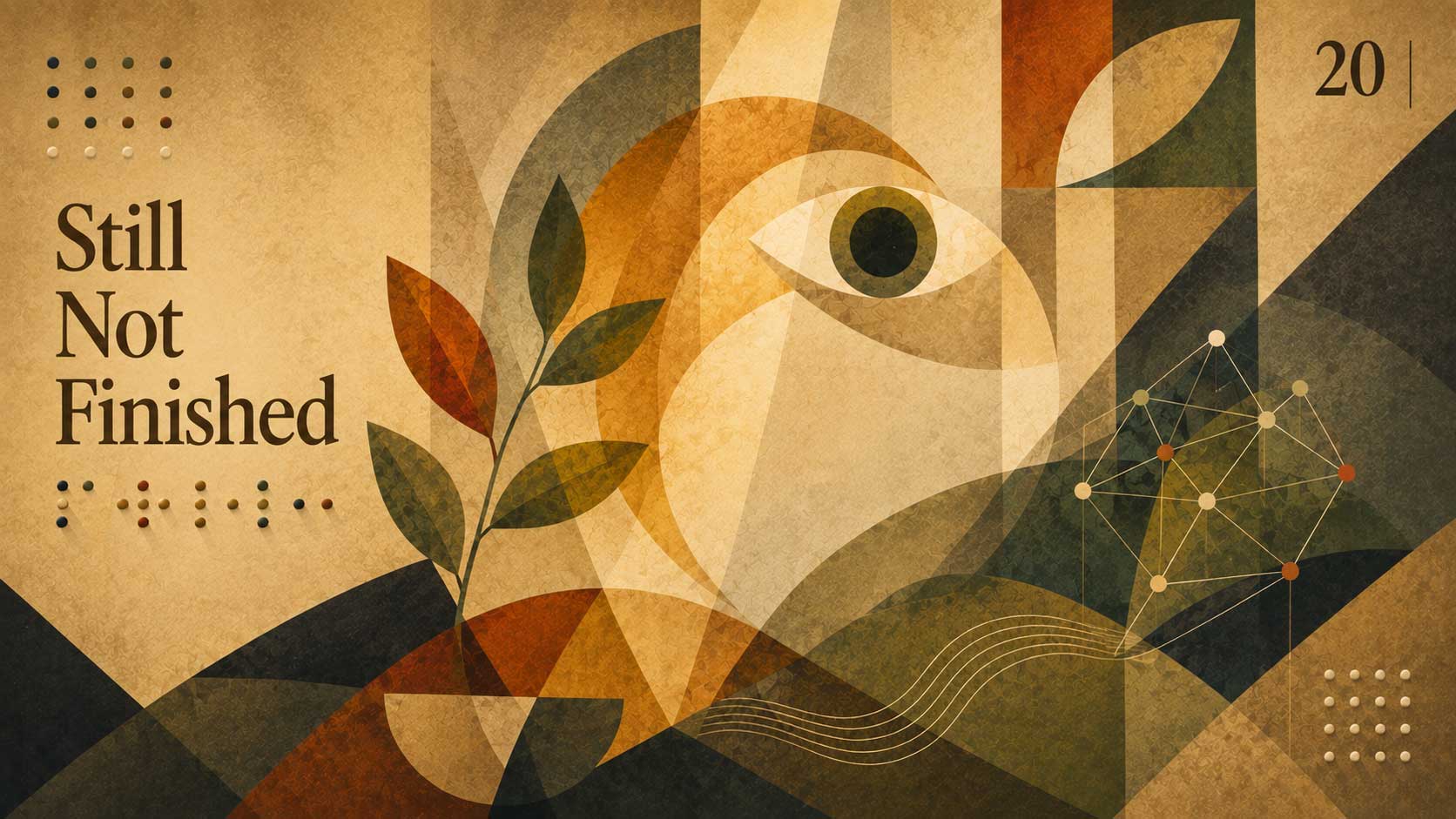
On the table was a list.
It was not a long list—just a few items, written in the kind of shorthand that only makes sense to the person who wrote it. Some were circled. One had a question mark beside it. Another had been crossed out, then rewritten, then crossed out again.
The list had been sitting there for weeks. Every time one item was dealt with, something else seemed to take its place.
It was not an unusual evening.
In fact, that was the point.
After twenty years, there should perhaps have been some moment when everything could be placed neatly into the category of completed work. Instead, the longer Antardrishti continued, the more unfinished things seemed to appear.
Perhaps that is what happens when an organisation is built around problems rather than products.
A product can be finished. A programme can have a closing date. An event can have a final day. But the problems that brought Antardrishti into existence do not disappear when a programme ends.
That was understood quite early.
Antardrishti began in 2006 with something as modest as a teacher-training manual. There was no grand ecosystem behind it, no elaborate structure and no certainty about where the work would lead. Over the years, one effort kept leading to another. Eye-care awareness led to teacher training and workshops. Eye-donation work grew into films, posters, jingles and the Drishti Yatra. Work with visually impaired people led towards theatre, a helpline and eventually the convention of educated and employed blind people. The magazine grew out of the need to communicate more widely, while the convention brought an even deeper understanding of what the community itself was asking for.
At the time, these things did not look like parts of an ecosystem.
They were simply answers to the next question.
The magazine, for example, was an attempt to make information travel. It spoke about eye care and prevention, eye donation, and the lives and possibilities of visually impaired people. It eventually became a trilingual publication. Although the magazine itself did not continue forever, the knowledge and stories accumulated through it did not simply disappear.
Years later, when Drishti Connect was revisited, the magazine archive was still part of what Antardrishti had built. The idea was to carry that knowledge forward through a resource hub, community exchange and other forms of public engagement.
The same thing happened with the convention.
Blind people had been brought together because their experiences needed to be heard directly. What emerged from those conversations did not remain inside the convention hall. The discussions, networks and understanding became part of the foundation for ideas that followed.
One of those ideas was Drishti Connect.
By now, there is no need to retell its entire story. What matters here is what its unfinished journey has come to mean.
Drishti Connect was never intended as a separate organisation sitting beside Antardrishti. It was conceived as a way of bringing together much of what had already been learned and built: eye-care awareness, eye-donation advocacy, empowerment of visually impaired people, information, experts, volunteers and community.
Its beta was launched in January 2017. The task today is not to invent the idea again, but to reactivate, reimagine and scale it.
That distinction matters.
For a long time, an unfinished platform could easily be seen as something that had not worked. But some ideas arrive before the conditions that can support them. Some need technology, resources or circumstances that do not yet exist. And some survive simply because the reason for creating them remains relevant.
Golden Eye Chef came from another direction, but the same pattern appeared there too.
When the idea of a cooking competition for blind people first emerged, there was no certainty that enough people would participate. Antardrishti was not part of the food industry and had no experience organising cooking competitions. Venues were difficult to find. Potential supporters questioned the need for blind people to cook. Even after the event became possible, there were still unexpected problems—right down to discovering, on the eve of the first competition, that the knives had somehow been forgotten.
The competition happened.
Then the world changed.
COVID forced the contest online. The online format created a different set of difficulties, especially for participants who had never recorded and submitted a cooking video before. Yet one participant found a way through a WhatsApp video call and screen recording. What began as a solution to a technical problem eventually helped open the contest beyond India.
A competition that had begun as a national event became international.
Again, something that looked like a problem became another possibility.
That pattern appears repeatedly across Antardrishti’s history.
The work rarely moved in a straight line. An idea appeared, an attempt was made, reality interfered, something changed, and eventually the idea either took another form or waited for another time.
Gradually, without having designed it that way from the beginning, the pieces began to connect.
The Ecosystem Strategy now describes this emerging structure as three connected layers.
At the centre is Antardrishti itself—the mission-driven foundation and the institutional and ethical backbone of the work. Around it are two very different platforms. Drishti Connect is intended to expand public engagement, visibility, participation and institutional involvement. Golden Eye Chef carries a different role, creating storytelling, cultural influence, emotional connection and international recognition.
Seen from that perspective, something becomes clearer.
The projects were never the mission.
They were ways of carrying the mission.
The names changed. The formats changed. The technology changed. The audiences changed. But the underlying questions remained remarkably similar: How can avoidable blindness be prevented? How can eye donation be encouraged? How can information become accessible? How can opportunities be created for visually impaired people? How can assumptions about what blind people can and cannot do be challenged?
The strategy for the next phase, therefore, is not simply to keep creating disconnected projects.
It is to connect what already exists.
The long-term objective is a connected ecosystem of inclusion, visibility, creativity, empowerment and sustainability. In that model, Antardrishti remains the mission, Drishti Connect becomes the ecosystem engine, and Golden Eye Chef becomes the flagship global brand.
That gives a different meaning to the word unfinished.
It does not mean that twenty years have not produced enough.
It means that twenty years have produced enough to build upon.
There is now a body of work behind Antardrishti: teacher-training workshops, eye-donation films and campaigns, the convention, the magazine, theatre, the helpline, Drishti Connect, Golden Eye Chef, and countless smaller experiments and encounters that never became large programmes but still changed what came next.
The work has accumulated.
So have the lessons.
A poster may lead to a conversation. A conversation may lead to a programme. A programme may create a network. A network may produce an idea. An idea may sit quietly for years before technology or circumstances make it possible again.
The magazine can become part of a digital knowledge platform.
The network created through the convention can become part of a wider community.
A cooking contest can become a global storytelling platform.
Something that once looked like an abandoned idea can become part of the infrastructure for the future.
That is why the crossed-out items on the list no longer tell the whole story.
Some things are genuinely finished.
Some should remain finished.
Some need to be changed.
And some are simply waiting for the right moment.
Twenty years also makes one thing clear: an organisation is never built only by the people who started it. People come into the work, contribute something, move on, return or disappear from everyday contact. Volunteers give their time. Participants trust Antardrishti with their stories. Collaborators bring knowledge that the organisation does not have. Sometimes a stranger answers an email and opens a door that had been difficult to find.
The work accumulates through people.
That is why the next stage cannot simply be about doing more.
It has to be about creating something that can connect more of those people, ideas and resources without losing the values that brought them together in the first place.
The Ecosystem Strategy is deliberate about this. After nearly two decades of work, the challenge is no longer simply proving that Antardrishti can begin something. It is about building a sustainable ecosystem while protecting the credibility and ethical character that made the work possible in the first place.
That is a very different challenge from the one faced in 2006.
Back then, the question was whether the work could begin.
Now the question is what can be built from everything that has been learned.
And perhaps that is why twenty years does not feel like an ending.
It feels like standing at the edge of one chapter with a much better understanding of the story than existed when the first page was written.
There are still people who have never heard the questions Antardrishti has spent these years asking. There are still families who underestimate what a blind person can do. There are still gaps in awareness, accessibility, opportunity and participation. There are still ideas that have not found their moment.
And there are still things we do not know.
That last part may be the most important.
When Antardrishti began, there was no way to know exactly what the work would become. The people encountered along the way kept changing the questions, challenging assumptions and creating possibilities that had never been part of the original plan.
Perhaps the next twenty years will do exactly the same.
The list is still on the table.
One item has been crossed out.
Another has been circled.
There is still a question mark beside one of them.
And there will probably be more.
After twenty years, that no longer feels like a problem.
It feels familiar.
It feels like Antardrishti.
Twenty years is enough time to look back with gratitude, but perhaps not enough time to declare the work complete. The point was never to reach a place where there was nothing left to do. The point was to keep finding meaningful things worth doing, and to leave each one strong enough to become the starting point for whatever comes next.
The list is still on the table.
There is still work to do.
And after twenty years, perhaps that is not evidence that anything was left unfinished.
It is evidence that the work is still moving.
Still not finished.