
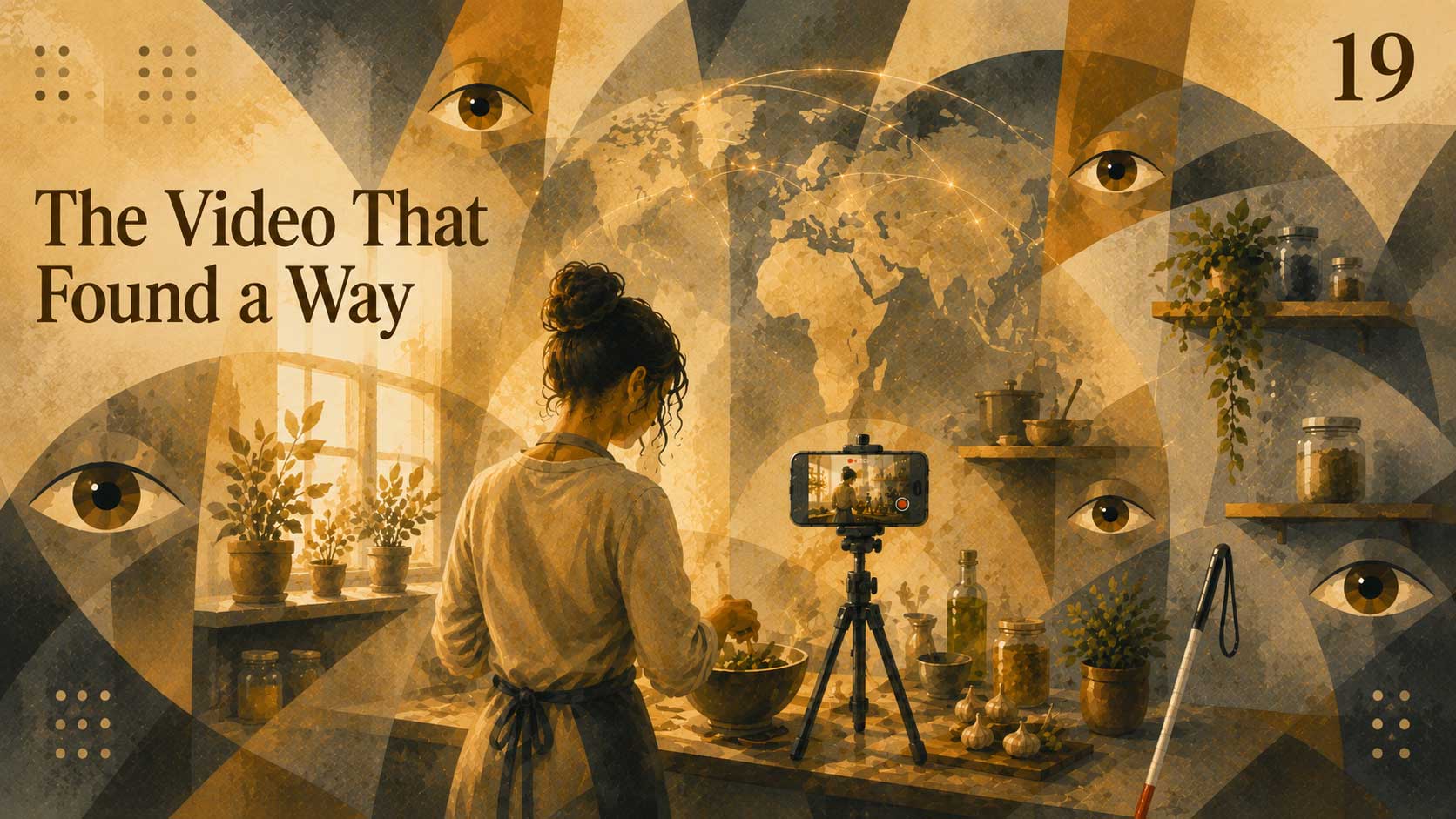
David Bogacz had not planned on entering a cooking competition.
When the idea was first mentioned to him, his reaction was hesitation. He enjoyed cooking, but a competition was something else. It meant preparing a dish for strangers to judge, being recorded while cooking it, and putting yourself forward in a way that can be uncomfortable even when you are confident in the kitchen. His family was surprised when he decided to accept the challenge.
A little later, he was standing in his kitchen in Uruguay preparing lamb.
The meat had been marinating for almost twenty-four hours. He had used Dijon mustard, tomato sauce, lemon, olive oil, cumin and ginger, and had added arazá jam, a fruit from northern Uruguay and southern Brazil that is not easy to find. He was preparing the lamb with onion, garlic, rosemary and red and yellow peppers. Natural potatoes and a medlar chutney would accompany it.
A camera was recording the whole process.
There was something wonderfully ordinary about the scene. It was a person in his own kitchen, cooking something he had planned carefully. Yet the video was travelling much farther than the kitchen itself. It was eventually watched by people sitting thousands of kilometres away, who would judge not only what he had cooked but how he had cooked it.
David had been losing his vision for many years. By then, he had retired from his work as a clinical neurophysiologist because his vision had deteriorated too far for him to continue. He was not completely blind, but his remaining vision was very limited. Cooking had become something he was learning in a new way, and a teacher at the Tiburcio Cachón Centre had encouraged him to take part.
He was the first participant from Uruguay.
He would eventually win the jury prize for the most creative dish as well as the public prize for the best recipe.
But David’s story could not have happened in that form a few years earlier.
To understand why, we have to go back to 2020, when the world around us suddenly stopped.
Until then, Golden Eye Chef had been a physical competition. In 2019, participants had travelled to India, cooked at different venues and appeared before a jury in person. We had learned, through all the chaos of that first edition, how much work was involved in bringing blind chefs into one physical kitchen.
Then COVID made that impossible.
There could be no travelling, no gathering of contestants and no crowded kitchens. We had to decide whether the competition would simply stop or whether we could find another way to continue it.
The obvious answer was to move it online.
It sounded much easier than it actually was.
We were accustomed to thinking about accessibility in physical spaces. We knew that a kitchen had to be arranged differently for a blind person, that equipment mattered and that small things which seemed ordinary to a sighted person could become significant barriers. Now the kitchen was no longer ours to arrange. Each participant was at home, using whatever phone, internet connection, kitchen and assistance were available to them.
We told people to record their cooking and send us the video.
Only then did we realise how much was hidden inside those few words.
For many participants, this was their first online cooking competition. Some needed help filling out the form. Some needed assistance positioning the phone and starting the recording. Others struggled with the size of the video files. Internet connections were slower than they are now, and sending a large cooking video could itself become a major task.
We began holding Zoom meetings to explain the process and answer questions. One meeting was followed by another because every participant seemed to encounter a slightly different problem. We were no longer standing beside someone in a kitchen, where we could simply look at what was happening and help. We were trying to understand problems from a distance, through phone calls and computer screens.
Almost everyone struggled in some way.
But almost everyone also kept looking for a solution.
One participant had particular difficulty finding a practical way to record her cooking. The normal method was not working for her, but she did not want that to stop her from entering. She contacted a relative or friend through a WhatsApp video call and arranged for the cooking to be seen through that call. She then used screen recording to capture the video and its audio.
It was not a sophisticated production.
It did not need to be.
It was a solution created with the tools she already had.
When the video finally reached us, there was something satisfying about it. We had spent days trying to explain how participants should record their entries, and she had simply found another route around the problem.
That experience changed something in our thinking.
Until then, the physical location of the contest had seemed like an unavoidable part of it. Participants had to travel to where the competition was being held. They had to reach the venue, enter the kitchen and cook there.
Online, the participant could stay in her own kitchen.
That did not remove all the difficulties. In some ways, it created new ones. But it removed one enormous barrier: distance.
And once distance stopped being a requirement, we began to wonder what else was possible.
The competition had started in India, but there was no reason that a cooking video had to come from India.
We began reaching out to organisations working with blind and visually impaired people in other countries. Volunteers helped us build a much larger database of organisations and contacts. Language was often a barrier, but technology helped us communicate across it.
Gradually, entries began arriving from outside India.
In 2022, Golden Eye Chef opened itself to the world.
That change was much bigger than adding a few international participants to an existing contest. We had originally wanted blind chefs from different places to have an opportunity to meet and learn from one another, because cooking methods are shaped by where people live, what ingredients are available to them, who taught them and what they have learned through experience.
The online format suddenly made that possible.
A chef could cook in India and another could cook in Uruguay. Someone else could enter from South Africa. They did not need to travel to the same kitchen for their cooking to be seen alongside one another.
That is how David eventually became part of the story.
When he was first told about the contest, he had been skeptical. He had never imagined that cooking could take him into an international competition. Yet his teacher encouraged him, and his family supported the decision.
He chose to prepare Kenny’s Lamb, a dish developed from an idea shared by his friend Kenny. He adapted it with ingredients that connected it to Uruguay, including arazá jam, and served it with potatoes and his own medlar chutney.
His video allowed us to enter his kitchen without ever travelling there.
We could see the food, hear him describe what he was doing and understand something about the way he had learned to cook. More importantly, the people watching him were not simply seeing a visually impaired man attempting to cook. They were watching a cook prepare a dish and compete with other cooks.
That distinction mattered.
Another participant, Morné van der Merwe, came from South Africa. He too had initially been skeptical when he was told about Golden Eye Chef. He and his wife are both blind, and he already cooked for them every evening. When he decided to participate, he prepared a pasta dish with fresh tomatoes, basil and Parmesan.
He explained that planning was central to his cooking. He knew where he kept things and relied heavily on sound and touch. He could hear the change in water as it reduced while cooking rice, and he could feel resistance when using a spoon in a pot. His methods had developed from experience rather than from trying to reproduce exactly what a sighted cook might do.
Stories like these began to change the nature of the contest itself.
The international participants were not simply coming to prove that blind people could cook. They were bringing their own methods, ingredients and food traditions with them. In return, they were discovering how other blind chefs approached the same challenges.
David later spoke about discovering cuisines and countries he had barely known before. For him, the competition was not only an opportunity to win something. It became an opportunity to encounter a world of cooking that had been outside his experience.
That was something we had not anticipated when we first moved online.
We had been trying to save a competition from a pandemic.
Instead, we had created a different kind of competition.
The first online edition had been difficult precisely because we were asking participants to use technology in ways they had never used it before. We had to hold meetings, explain processes, solve technical problems and watch participants invent their own methods of recording and submitting their entries.
But every time someone found a way around a problem, the possibilities became a little larger.
The participant who used a WhatsApp video call had only been trying to submit her entry.
David had only been trying something he had initially been reluctant to do.
Morné had only been accepting an opportunity he had first viewed skeptically.
None of them knew that their videos were helping to change the geography of the contest.
By the following years, Golden Eye Chef had participants from countries as far away as the United States, Mauritius, North Macedonia, Uruguay and South Africa. What had begun in India as a physical cooking competition had become an international platform.
And perhaps the most interesting part was that the technology had not replaced the kitchen.
It had carried the kitchen to us.
A video could show the ingredients on a counter in Uruguay, the cooking methods of a chef in South Africa, or the ingenuity of a participant somewhere in India who had found a way to record her entry with a WhatsApp call.
The screen had become a meeting place for kitchens that could never have been brought together physically.
Looking back, we had initially seen the move online as something forced upon us by circumstances. We were simply trying to continue when the physical world had become unavailable. We did not know that the same decision would eventually allow Golden Eye Chef to become the world’s only international cooking competition exclusively for blind and visually impaired chefs.
The journey from that first difficult online submission to an international contest was not planned as a grand transformation. It happened through hundreds of small acts of persistence: a participant trying again, a volunteer solving a technical problem, someone helping another person record a video, an organisation responding to an email from another country, and a cook deciding to take a chance on something completely unfamiliar.
It began with a video that simply needed to find a way to reach us.
Once it did, we realised that the distance between two kitchens was not as large as we had always thought.