
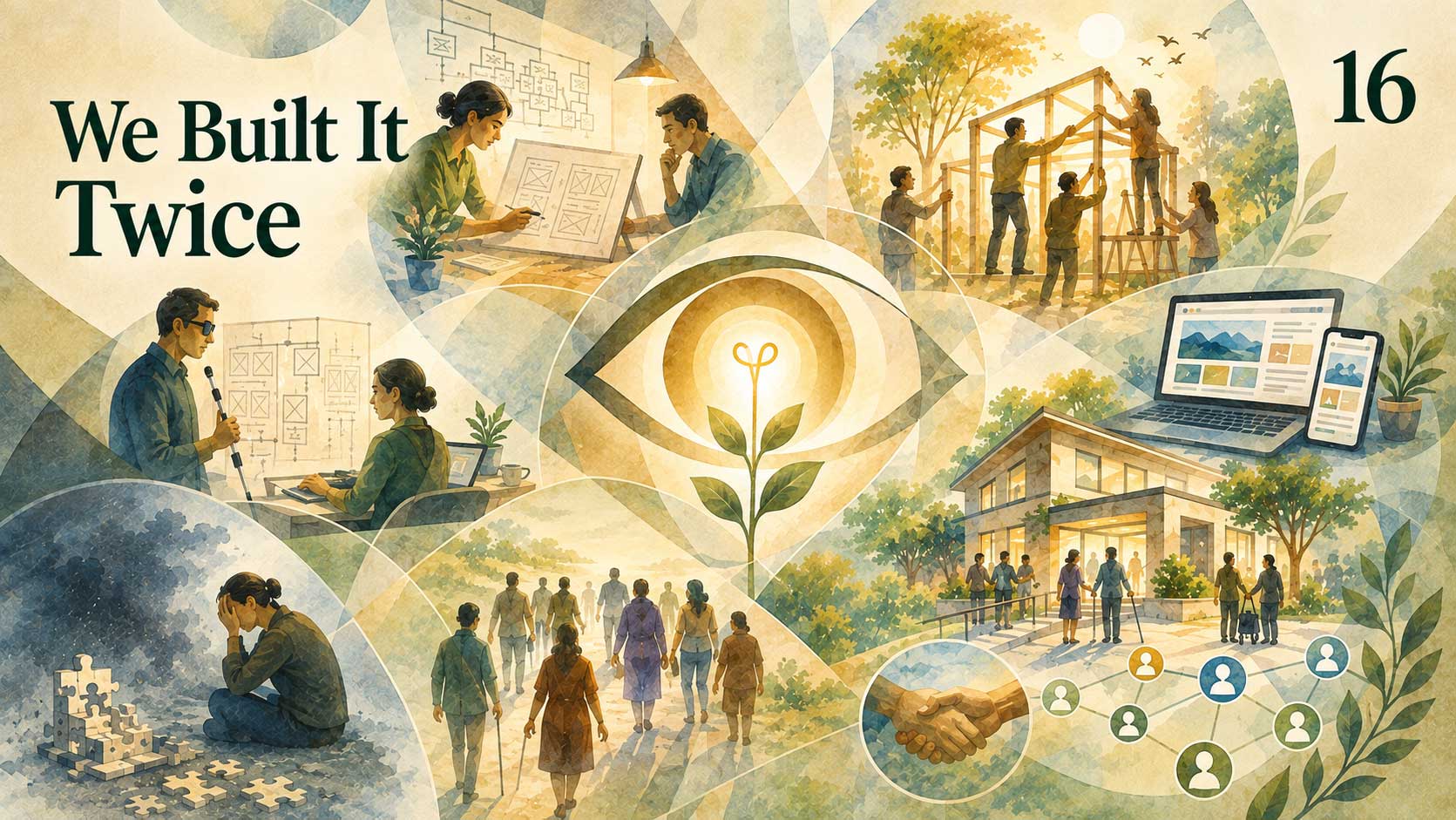
The room was full of women who knew how to make technology do things we could only describe.
It was 2015, and the Anita Borg Institute for Women and Technology India had organised a Tech For Good Hackathon as part of the Grace Hopper Celebration. Several teams of women working in technology had gathered to take on challenges presented by organisations like ours.
Our challenge was Drishti Connect.
We were not sitting in the hackathon room watching the teams work. Our involvement happened remotely, through emails, shared material and Skype calls. We explained what we were trying to build, shared the wireframes and answered questions as the teams worked on their ideas.
Then the presentations began.
Different teams showed what they had developed for the challenge. We received their ideas, discussed them with the organisers and looked at what each team was proposing. Some of the submissions were similar, and the organisers later explained that where different teams had arrived at similar solutions, a minimum viable product could be developed by bringing together the common features. The application would then be handed over with its source code, followed by a period of support and training.
Among the finalists was Team Five Stars, the PayPal team. They had developed an application for Antardrishti based on the wireframes we had shared with them.
We were then asked to evaluate the applications, decide which one we preferred and which team we wanted to work with for the final development. After the discussions and demonstrations, Team Five Stars from PayPal was selected for the final development of the Antardrishti application.
For us, this was the first time Drishti Connect began to look like something more than an idea.
Until then, we had spent a lot of time explaining what we wanted the platform to do. Now we were looking at an actual application being developed from those explanations.
The process itself was interesting. We would discuss something over email or a Skype call, explain what we wanted the user to be able to do, and then see the idea translated into a screen. Something that had existed as a wireframe or a sentence in a proposal was becoming clickable and functional.
The hackathon had taken an idea that we could describe and given it a technological form.
The beta version of Drishti Connect was eventually launched in January 2017. It was intended as a one-stop solution through which visually impaired people could seek help with practical problems and find information, resources or people who could assist them.
We were excited about what it could become.
But the launch also taught us something that was much harder to understand when we were still building it.
Building something and sustaining it are two different things.
The hackathon had brought together technology professionals for a particular challenge. They had helped turn our idea into an application, but once that development phase was over, the responsibility for maintaining and developing it remained with us.
There were changes we wanted to make and things we wanted to add. The platform itself was also becoming more ambitious. What had initially been conceived around the needs of visually impaired people was expanding to include eye care and eye donation, along with resources, discussions, experts, volunteers and other possibilities.
The more we imagined, the more the platform needed.
And we did not have unlimited resources to keep developing it.
Eventually, the first version became inactive.
There was no dramatic moment when someone declared that the project had failed. It simply became difficult to keep moving. Other work demanded attention, resources were limited, and the platform gradually became something we had once built but could no longer develop in the way we wanted.
For a while, that could have been the end of the story.
But the work that had created the need for Drishti Connect did not stop.
We continued working with visually impaired people. We continued our eye-care and eye-donation work. We created films, posters and educational material. We organised programmes, worked with volunteers and kept encountering the same kinds of problems that had originally led us to imagine Drishti Connect.
The platform had become quiet.
The need had not.
Years later, we returned to the idea.
This time, we were not starting from the same place.
The first time, we had an idea and needed technology to give it a form. Now we had years of experience, resources, content and relationships that needed to be brought together.
The current strategy describes Drishti Connect as something that was already beta launched in 2017 and now needs to be reactivated, reimagined and scaled, rather than treated as a completely new experiment.
That changed the way we approached the second build.
We understood that accessibility could not be something added after the platform was built. A platform intended for blind and low-vision users had to be designed around screen readers, voice access and different levels of digital access from the beginning. The current technical plan therefore places accessibility and low-bandwidth access at the centre of the system.
We also understood that Drishti Connect could not simply be a website.
The new vision connects the digital platform with the physical work we have been doing for years—awareness programmes, volunteers, institutions, hospitals, eye banks, experts, visually impaired people and the wider public.
So the second build is not simply a newer version of the first one.
The first time, we were trying to turn an idea into an application.
The second time, we are trying to turn years of experience into a sustainable ecosystem.
Looking back, I don’t think the first build was a failure. It gave us something much more valuable than a piece of software. It showed us what happened when an idea was placed in the hands of people who knew how to build technology. It also showed us what we had not yet understood about maintaining that technology ourselves.
The first build proved that Drishti Connect could exist.
The years that followed taught us what it needed to survive.
And that is why we went back to it.
We could have abandoned the old platform and started something completely different. Instead, we returned to the same idea, looked at what the first attempt had given us, looked at everything that had changed since then, and decided to build again.
The first time, we needed people with technical skills to help us make the idea real.
The second time, we had something the first build could never have given us on its own: years of experience knowing what the idea actually needed.
We built it once because we believed it should exist.
We built it again because we had learned how to give it a better chance of surviving.We built it twice. The second time, we brought the first attempt with us.