
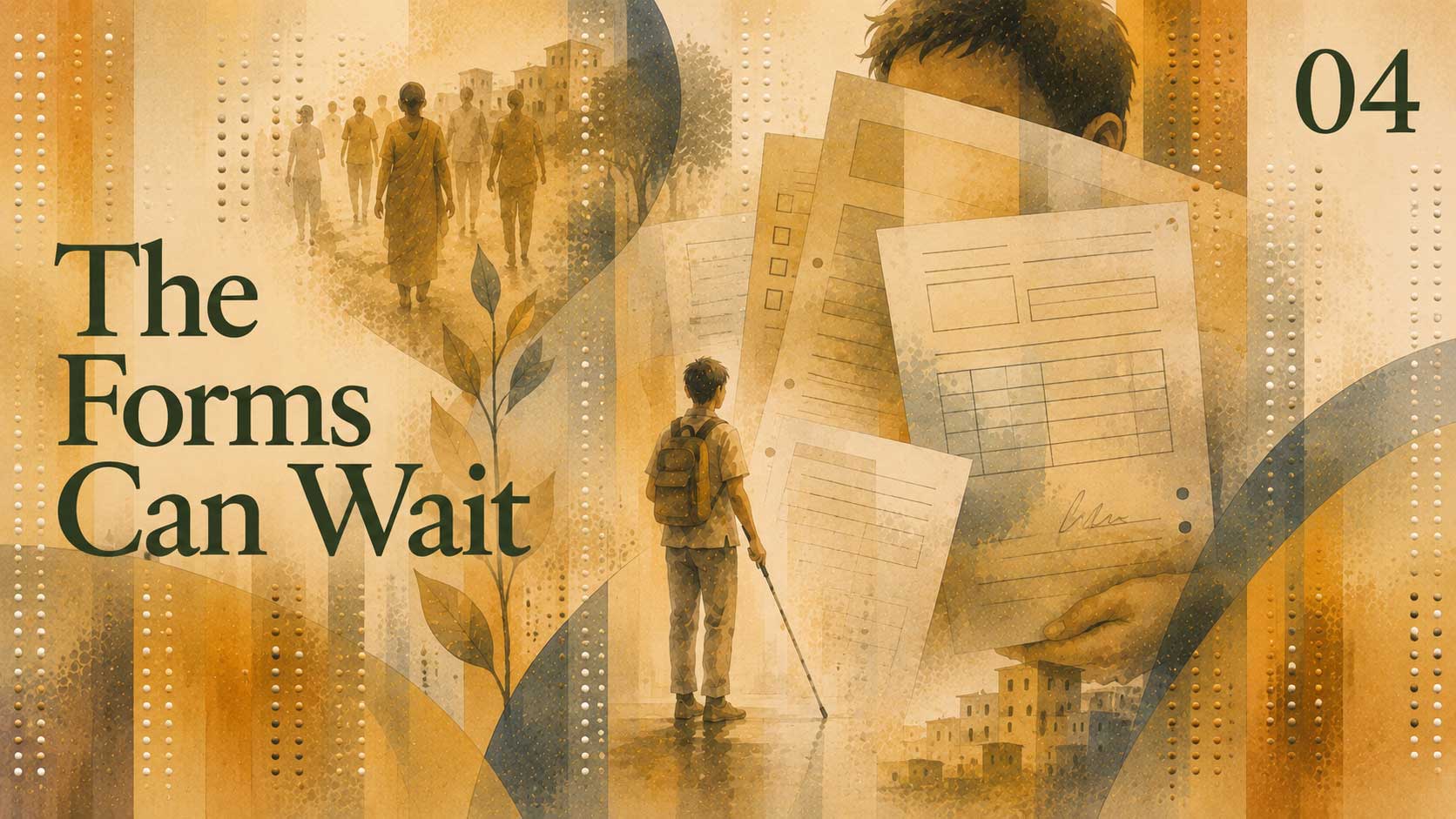
“NGO people come, make us fill out forms, raise funds in our name, and then use our names for their own benefit. What do we get? Nothing. Just become a member of this organisation, become a member of that one.”
The words came from somewhere across the classroom. They were not spoken angrily, and there was no confrontation in the room. The student said them with the tired certainty of someone describing something he had already seen too many times. We had gone to a school for the blind to meet students, listen to their experiences and understand what kind of connection they might want with a new organisation. Antardrishti was still young, and we were trying to bring people together through the Antardrishti Forum for Friends of the Blind, where blind people, their families, friends and others could meet, exchange experiences and discuss the issues affecting their lives.
Until that moment, the conversation had been easy. Students talked about their studies and examinations, about looking for work and about the ordinary difficulties that become complicated when the world around you has been designed without considering blindness. We were listening as much as we were speaking, trying to understand lives that were still relatively unfamiliar to us. Then we began explaining the idea of bringing people together and asked whether they would like to be associated with us. That was when the mood shifted.
The student’s words were not really directed at Antardrishti. He was talking about a pattern he had already experienced. Organisations came, asked people for their names and details, made them fill out forms and invited them to become members. Sometimes another organisation came and repeated the process. There was always another association, another membership, another list. What seemed to matter to the people sitting in that classroom was not how many organisations they had been associated with, but what had actually changed after their names were collected. His question—Humein kya milta hai? What do we get?—was difficult precisely because it was so simple.
At first, we had looked at forms differently. When you are trying to build an organisation, collecting names and contact details seems like an ordinary part of getting organised. You need to know whom you have met, how to stay in touch and who wants to participate. There is nothing suspicious about a name written on a piece of paper. But sitting in that classroom, it became clear that a form does not carry the same meaning for everyone. For us it was administration; for someone who had already been approached by several organisations, it could feel like the beginning of another promise that might never be fulfilled.
Some of the people we met had their own stories about organisations that had collected their details, made them members and then disappeared without anything changing in their lives. Whether every story was true was impossible to know, but the mistrust itself was real. They had learned to be cautious whenever someone arrived asking for their name.
The conversation also made us think about why organisations were so interested in having people on their lists in the first place. In the social sector, numbers can become surprisingly important. Someone who wants to donate may begin with a question such as, “How many blind people do you have?” It is an understandable attempt to measure reach, but it can also create an incentive to collect more and more names because a larger number can make an organisation appear larger, more established and more deserving of funding. The danger is that the person can gradually disappear behind the number: a human being becomes a beneficiary, the beneficiary becomes a statistic, and the statistic becomes part of an organisation’s claim about its own impact.
We did not want to build Antardrishti that way. We were looking for blind people because we wanted to meet them, understand their lives and work on issues that actually mattered to them. We did not want to create a list of “our” blind people simply so that the organisation could present a larger number to someone who might fund it. The people we met had their own lives and choices, and helping someone did not give us ownership over their story. This was also why, over time, we stopped thinking of membership as the first step in a relationship.
The change was not dramatic. There was no meeting in which a new rule was announced, and there was no moment when we suddenly decided that forms were bad. It was more gradual than that. Each conversation added another piece to the understanding that if someone came to us with a problem, the problem itself should come before the paperwork. A person did not need to become a member before we could listen to them, and they did not need a membership number before their difficulty became worthy of attention. If they later wanted to be associated with Antardrishti, that could happen naturally.
Looking back, that school visit seems like one of those small moments in which an organisation quietly discovers what it does not want to become. We had gone there thinking about how to bring people into a new forum; we came away thinking more carefully about why people might not want to be collected into another organisation’s list. The difference was not between wanting to help and not wanting to help. It was between helping people and collecting people.
Perhaps that was the lesson hidden inside the student’s question. He had not asked us how many people we could bring together, how many members we could register or how large the Forum might become. He had asked the question that mattered to him: What do we get?
We did not have a clever answer.
What we could do was make sure that the answer would not be another form.
Trying to help without understanding what people actually experience is a form of blindness in itself. And from that point on, whenever a person came to us, the person came first. The paperwork could follow if it was genuinely needed.
The forms could wait.